Explain How You Can Find the Area of a Cross Section of a Column When You Know Its Circumference.
Key Terms
o Circle
o Equidistant
o Radius
o Diameter
o Circumference
o Pi (π)
Objectives
o Identify some basic parts of a circle, such as the radius and bore
o Calculate the circumference of a circle
o Calculate the area of a circle
In this article, we will consider a geometric figure that does not involve line segments, but is instead curved: the circle. Nosotros volition employ what we know nigh algebra to the study of circles and thereby determine some of the properties of these figures.
Introduction to Circles
Imagine a point P having a specific location; next, imagine all the possible points that are some stock-still altitude r from signal P. A few of these points are illustrated beneath. If we were to draw all of the (infinite number of) points that are a distance r from P, we would end upward with a circle, which is shown below as a solid line.
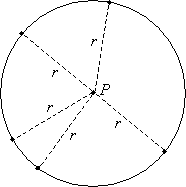
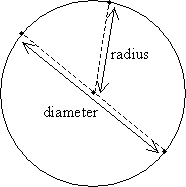
Thus, a circle is simply the set of all points equidistant (that is, nonetheless distance) from a center point (P in the example higher up). The altitude r from the center of the circle to the circumvolve itself is called the radius; twice the radius (twor) is chosen the diameter. The radius and diameter are illustrated below.
The Circumference of a Circle
Every bit with triangles and rectangles, we can attempt to derive formulas for the area and "perimeter" of a circumvolve. Unlike triangles, rectangles, and other such figures, the distance effectually the exterior of the circle is chosen the circumference rather than the perimeter-the concept, withal, is essentially the same. Calculating the circumference of a circle is not as easy every bit calculating the perimeter of a rectangle or triangle, however. Given an object in real life having the shape of a circumvolve, one approach might exist to wrap a cord exactly one time around the object and and so straighten the cord and mensurate its length. Such a process is illustrated below.
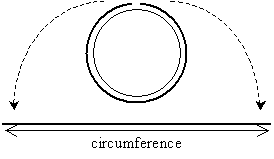
Evidently, as nosotros increment the bore (or radius) of a circumvolve, the circle gets bigger, and hence, the circumference of the circle also gets bigger. We are led to recollect that there is therefore some relationship between the circumference and the diameter. As it turns out, if we measure the circumference and the diameter of any circle, we ever find that the circumference is slightly more than three times the diameter. The two case circles below illustrate this betoken, where D is the diameter and C the circumference of each circle.
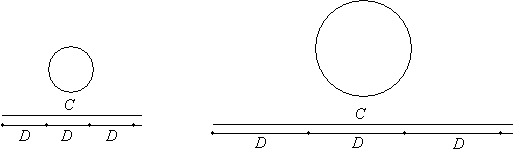
Again, in each instance, the circumference is slightly more than three times the bore of the circle. If we divide the circumference of any circle by its diameter, we stop up with a constant number. This constant, which nosotros label with the Greek symbol π (pi), is approximately three.141593. The exact value of π is unknown, and it is suspected that pi is an irrational number (a non-repeating decimal, which therefore cannot be expressed as a fraction with an integer numerator and integer denominator). Permit'due south write out the human relationship mentioned above: the quotient of the circumference (C) divided by the diameter (D) is the constant number π.

Nosotros can derive an expression for the circumference in terms of the diameter by multiplying both sides of the expression above past D, thereby isolating C.


Because the diameter is twice the radius (in other words, D = 2r), we tin substitute iir for D in the above expression.
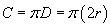

Thus, we can calculate the circumference of a circle if we know the circumvolve's radius (or, consequently, its bore). For most calculations that require a decimal reply, estimating π every bit iii.fourteen is often sufficient. For instance, if a circle has a radius of three meters, then its circumference C is the following.


The respond above is exact (even though it is written in terms of the symbol π). If nosotros need an approximate numerical respond, we can estimate π as 3.fourteen. And so,


The symbol ≈ simply ways "approximately equal to."
Practice Trouble: A circumvolve has a radius of 15 inches. What is its circumference?
Solution: Let's start by cartoon a diagram of the situation. This approach can be very helpful, peculiarly in situations involving circles, where the radius and diameter can hands be confused.
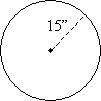
Considering we are given a radius, we must either calculate the circumference (C) using the expression in terms of the radius, or we must convert the radius to a diameter (twice the radius) and employ the expression in terms of the bore. For simplicity, nosotros'll use the onetime approach.


This issue is exact. If we need an approximate decimal effect, nosotros can use π ≈ 3.14.


The Area of a Circumvolve
Just every bit calculating the circumference of a circle more complicated than that of a triangle or rectangle, so is calculating the area. Let's endeavor to go an estimate of the area of a circumvolve by drawing a circumvolve within a square as shown below. The surface area of the circle is shaded.
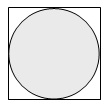
Let's draw a vertical diameter and a horizontal diameter in the circle; we'll label these diameters as having length D. Note by comparing with the square, the square must therefore have sides of length D as well.
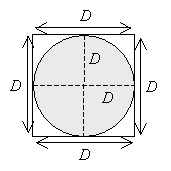
We know that a foursquare (which is a rectangle whose length and width are equal) with sides of length D has the following expanse A foursquare (note that we add a subscript to place this area as the area of the square-we will add a like subscript in the case of the area of the circle):

Considering the circle of bore D obviously has a smaller area than the foursquare with sides of length D, we know that the circumvolve's expanse must be less than D 2. By inspection, we can guess that the area A circle of the circle is approximately iii-fourths that of the square. Thus,

As information technology turns out, this gauge is close to the actual issue. Through some more-complicated mathematics that is across the scope tutorial, information technology tin be shown that the surface area of a circle is exactly the following:

Find that the number π once once more appears. Let's at present compare this exact issue with our gauge from above. We'll simply do some rearranging of the expression, keeping in mind that the radius (r) is equal to half the bore (D)-in other words, D = twor.

Since D = 2r, then


Permit'due south substitute this value for r into the expression for the area of the circumvolve; nosotros must brand the substitution twice. We can then simplify the expression somewhat.
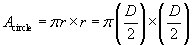


Since π is approximately 3.14, then
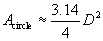
Thus, our guess was very shut to the actual area!
Exercise Trouble: A circle has a diameter of 6 centimeters. What is its expanse?
Solution: Note carefully that the diameter is given, not the radius. Thus, if we are to use the expression for the surface area in terms of the radius, we must convert the bore to a radius (simply past dividing the bore in half).


We can now summate the area using the following formula.



Again, this answer of 9 square centimeters is exact. But,


This is an approximate consequence, but would be sufficient in many contexts.
Practice Problem: A circle has a circumference of 8π feet. What is its area?
Solution: We learned that the circumference is closely related to the radius (and bore). Thus, using this known value of the circumference, we tin calculate the radius and use it to find the area. First, let'south solve the expression for the circumference to get the radius.


Nosotros desire to isolate r; we can use the same approach as we used when solving linear equations.
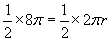

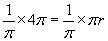

Now that we know the radius of the circle, we tin summate its area.


Or,


Source: https://www.universalclass.com/articles/math/pre-algebra/how-to-calculate-circumference-area-circle.htm
0 Response to "Explain How You Can Find the Area of a Cross Section of a Column When You Know Its Circumference."
Enregistrer un commentaire