Commentary: South Koreans wring hands over removing mask rules for the vaccinated
SEOUL: On mountains in South Korea, everyone knows the pandemic etiquette.
You can hike without your mask on, only if y'all see someone coming your mode on the trail, yous must put it back on, or make some other effort to encompass your face as you pass them.
Many substitution nods or a hello and in one case several steps past the other hiker, people tend to remove their masks and keep equally earlier.
Hiking is South korea'south national pastime and mountain trails are among the few public places where going around without a mask on is somewhat unofficially accepted.
READ: Commentary: Variants versus vaccines is becoming the new COVID-19 race
Throughout the pandemic, as the authorities has enacted a series of indoor and outdoor mask mandates of escalating strictness, mountain trails have been a respite from crowded urban spaces.
Since Oct 2020, afterwards a huge surge in infections, masks were made mandatory in all public places, whether when taking public transportation, in medical care facilities or in outdoor spaces, including parks.
Even while exercising outdoors, in a gym, dance studio or at Taekwondo lessons, people had to put on a mask. Exceptions are made for athletes participating in games.
Anyone failing to mask up could face up a fine of around United states$ninety.

Now, equally South korea appears to be taking steps toward the cease of the pandemic, mask etiquette is loosening on the trails before anywhere else. On hikes in recent weeks, I've come across groups of heart-anile people all with their masks pulled downwards over their chins or off entirely.
No one really makes a fuss, despite it beingness prohibited.
GROWING CALLS FOR LENIENCY ON MASK WEARING
At that place are a few reasons for this accepted leniency.
More than than a year into the coronavirus pandemic, S Koreans have been sensitised to the prevailing infectious disease agreement that the virus spreads mostly in indoor, crowded and poorly ventilated spaces. Clusters in the country have been mostly bars to medical facilities, offices and religious events.
READ: Commentary: Wear your mask properly! Uncovering the reasons behind public mask shaming
To most South Koreans, an outdoor space seems unlikely to be a venue for transmission. As a physically strenuous activity, hiking likewise leads to rapid, heavy breathing, which can be uncomfortable with a mask on.
Yet these attitudes are also cogitating of a growing optimism that the dominion tin be relaxed and hope that the COVID-19 saga is entering its final human activity. The number of new cases has been stable at several hundred per twenty-four hour period for months, with people desensitised to fresh reported infections.
Despite initial hiccups in securing sufficient supplies because of a reliance on the multilateral COVAX initiative, the country is upbeat that vaccinations, which began in February, will proceeds pace.

As of early this calendar week, only around 5.4 million people in a country of 52 1000000 had received at least one vaccine shot. Only the South Korean government recently signed deals with the US to acquire enough vaccine supplies to inoculate the whole country.
A partnership between Moderna and Samsung to ramp up production in the country is set to be inked.
READ: Commentary: Why is COVID-19 surging in the earth's almost vaccinated land?
DANGLING INCENTIVES
Yet the tide is turning and the bigger stumbling block to getting shots in arms may be public indifference and complacency. Although daily new infection numbers are high, fatality rates have come up down to the single digits.
To keep building that momentum and encourage more people to get vaccinated, the government has now dangled the carrot of tentative returns to normalcy.
In July, fully vaccinated people will be permitted to go maskless in outdoor spaces and hold family gatherings with as many every bit viii people, up from the current 4, officials appear in end-May.
The government's program is to press total steam ahead with vaccines over the summertime toward the goal of achieving herd immunity by November, and with any luck, heading into 2022 with COVID-xix in the country's rearview mirror.
READ: Commentary: Why are some countries giving people freebies to go vaccinated?
CONCERNS OVER FOREGOING MASKS
Even after the goal of herd immunity is reached, in that location will remain the mostly psychological question of when information technology is time to forego masks entirely.
While in the early stages of the pandemic there were legitimate questions about how effective, if at all, masks were in limiting the spread of coronavirus, there is a firm consensus in the country that while not totally effective, masks are an inexpensive, hands distributed tool that can limit the spread of airborne ailments.
Few serious observers now doubtfulness the wisdom of mandates like those in South korea that require everyone in closed spaces like offices and public transit to don masks that cover their mouths and noses.
Indeed, in South korea and other Eastward Asian countries, face masks are not associated with any political identity and do not conduct the culture-war baggage they accept acquired in the West.
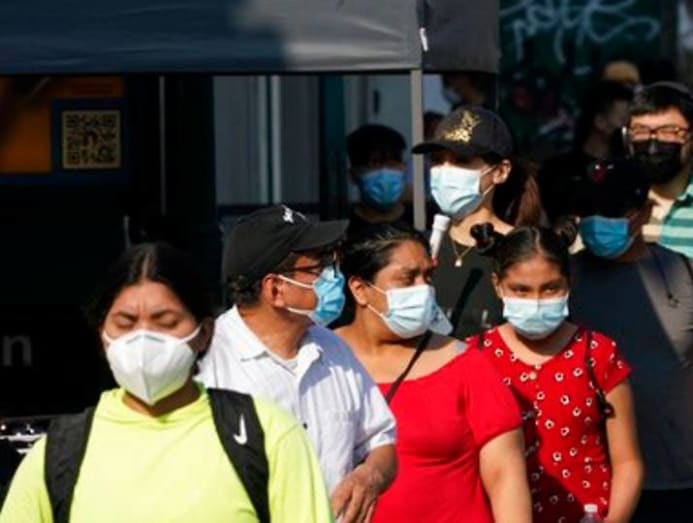
Masks were non an uncommon sight in indoor spaces even before the pandemic. South Korean companies practise not customarily offer paid sick leave to workers who feel nether the atmospheric condition; before COVID-19 came along. Anyone with the sniffles was expected to suck information technology upward and come up to the office, though COVID-19 has created public force per unit area for firms to review their sick go out policy.
Workers feeling like they might have a cold or flu would wear a face mask both to protect themselves from exposure to harmful bacteria and reduce the risk of passing their germs to someone else.
Given that South Koreans generally don't consider masks a major inconvenience, most people hither are ill of the impediment to socialising that masks present by making information technology almost impossible to read facial expressions.
S Korea leaders know this. When coming together with a group of kids on the Children's Twenty-four hours vacation in May, President Moon Jae-in told the youngsters he hoped they would be able to play with friends without masks "every bit soon as possible."
(Are COVID-19 vaccines still constructive against new variants? And could these increase the risk of reinfection? Experts explain why COVID-xix could go a "chronic trouble" on CNA's Eye of the Thing podcast.)
MASKS MAY STAY ON FOR MOST IN THE Stop
Nevertheless, while there is general public keenness to go back to normal, many South Koreans seem content to keep some degree of mandated mask wearing.
A contempo survey by the Korea Lodge Stance Constitute constitute that 45 per cent of respondents felt that even vaccinated people should nevertheless exist required to vesture masks in outdoor spaces.
How soon that happens will depend on the country's success in carrying out vaccinations and the efficacy of those shots, just likewise on the possible emergence of coronavirus variants.
The country has been vigilant in testing and tracking the small trickle of travellers who come in. Just the more transmissible variants could pose a tricky dilemma of how much risks are accustomed in return for personal freedoms.
READ: Commentary: Some pain even equally Singapore rises to the claiming of tighter COVID-19 measures
As a country, Republic of korea has withstood state of war and economic crunch and those historical memories take prepared people here with the dust needed to push through the coronavirus pandemic. Those historical memories have likewise inculcated a sense of caution.
While hikers and everyone else is eager to get back to normal, people here volition non celebrate too early on.
On streets in almost all other public places, mask-wearing is notwithstanding compatible.
Mr Moon recently said that quarantine measures will be adapted in Oct, when the plan is to have around 70 per cent of the population vaccinated. Until and so, and perhaps subsequently, masks and a full general sense of caution are hither to stay.
Steven Borowiec is a journalist based in Seoul.
0 Response to "Commentary: South Koreans wring hands over removing mask rules for the vaccinated"
Enregistrer un commentaire